Sign Up for our Newsletter!
1-866-UGO-WILD (846-9453)

Posts Tagged ‘beluga whales’

Underwater with Beluga Whales in Hudson Bay

World explorers visiting our remote polar bear ecolodge on the coast of Hudson Bay this year saw beluga whales in record-breaking numbers while enjoying one of the best summers in years. The remote location of Seal River Heritage Lodge ensures countless unique wildlife encounters both by land and sea but this season our beluga swim encounters were nothing short of spectacular.

The stunning footage in the video below was shot this summer less than a kilometer from the Lodge by one of our intrepid snorkelers after he was “adopted” by a pod of over 80 beluga whales. We typically have 3,000 to 4,000 beluga whales summering off the shore here at the Lodge, but the numbers this season might have been close to double that. Truly a wildlife extravaganza!

YouTube Preview Image

Mariachi Beluga Whale

YouTube Preview Image

Swim with Beluga whales! An Arctic Safari where you can walk with Polar Bears!

How do you pack for a trip to Seal River Heritage Lodge?  Just floating an idea for any of our Mexican guests…

Beluga Whales in Churchill – 10 Things You Might Not Know

Swimming with Beluga Whales in Hudson Bay near Seal River

Beluga whales are friendly!

by Vanessa Desorcy

Most of the time, polar bears overshadow other arctic wildlife on our Churchill Wild adventures.  Beluga whales are another species prevalent around Churchill in the summer however, and since they’re a popular part of our Birds, Bears & Belugas adventure, we thought it might be nice to share with you a few things that we find interesting about these friendly-faced mammals.

  1. While you likely know that beluga whales are white, it’s unlikely you’re aware that the name ‘beluga’ comes from the Russian word “Belukha” which means white.
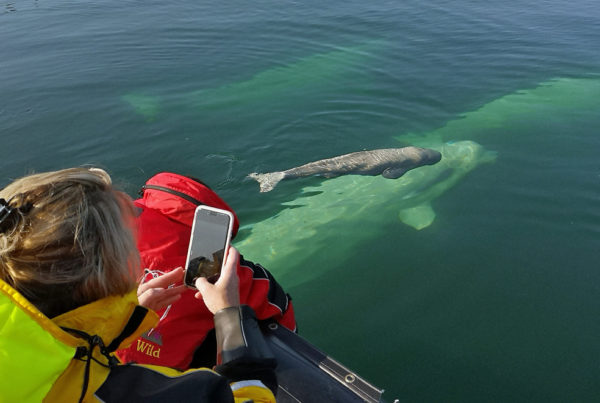
  2. Beluga whales are also known as “sea canaries” due to the unique and varied sounds they make.  On our Birds, Bears & Belugas adventure at Seal River Heritage Lodge, we offer guests a chance to snorkel with the belugas, and those who have done so can testify to the fact that humming and chirping attract these friendly creatures!
  3. Ghostly white Beluga Whales in Hudson Bay

    Ghostly White - Beluga Whales in Hudson Bay

    Baby belugas are born gray and turn white as they age.  Due to their darker color, they are thought to be more difficult to spot by predators such as polar bears and killer whales. Most belugas are completely white around the age of 13 when sexual maturity is reached.

  4. Belugas are very sociable and as such, their sense of touch is very important.  It is not unusual for belugas to come close enough to the boats and snorkelers to be touched.
  5. Beluga whales undergo a seasonal molt, unlike other cetaceans which shed continuously.  They rub against rocky river bottoms to shed their skin, which could be why they’re often found in shallow water in the summertime.
  6. Belugas, like other toothed whales, have a life expectancy of 30-40 years, nearly half that of the average life expectancy of most baleen whales.
  7. Beluga Ballet - Photo by Kike Calvo

    Beluga Ballet - Photo Credit: Kike Calvo

    In the summer, belugas are often found in warm-water estuaries and river basins, making our Lodge, located near the Seal River estuary, an ideal place to view them.

  8. The seven vertebrae in a beluga’s neck are not fused, which gives them the ability to turn their heads and even nod!
  9. The lack of a dorsal fin enables beluga whales to swim just below ice sheets to locate breathing holes.  Their lack of a dorsal fin also means less surface area, minimizing heat loss when in Arctic waters.
  10. Spot the difference:  Male belugas can be distinguished from females by the upward curve at the top of their flippers as well as by their size.  Adult males can weigh up to 1500 kg, while mature females weigh in at about 1350 kg.

Oh, and one more thing we’ve learned from guests on our Birds, Bears and Belugas adventures – swimming with Belugas is a fun!

Related Posts:

Churchill Wild Birds, Bears and Belugas trip featured in L.A. Times Travel Section
Swim with beluga whales. Conquer your fears.

Churchill Wild Birds, Bears and Belugas trip featured in L.A. Times Travel Section

Freelance journalist Margo Margo Pfeiff  was at Churchill Wild this past July and experienced our Birds, Bears and Belugas holiday first hand.

Beluga Whales at mouth of Seal River on Hudson Bay

Beluga Whales at mouth of Seal River on Hudson Bay

Not one to sit on the sidelines and simply observe, Margo was the first one in the water to swim and snorkel with the beluga whales. She also showed no fear of the polar bears (or the birds) while hiking over the tundra birdwatching and bear watching. Below follow a few short excerpts from her article:  The Arctic warmth of Hudson Bay’s belugas, which appeared in the Los Angeles Times Travel Section.

“I am beluga bait. Bobbing at the end of a rope tied around my feet, I am being slowly towed in the wake of a Zodiac, a small, inflatable boat, through the icy waters of Hudson Bay. Clad in a partly inflated rubber dry suit, I look like a Michelin Tire Man who has sprouted a snorkel as I peer into the murky brown, tannin-stained cocktail of salt and freshwater. I have come all the way to far northern Manitoba, Canada, to snorkel with beluga whales that, if they do appear out of the gloom, will likely scare the daylights out of me. As my heart races…” Read full article in the Los Angeles Times Travel Section article

Snorkeling with Beluga Whales on Hudson Bay - Dennis Fast photo

Snorkeling with Beluga Whales on Hudson Bay - Dennis Fast photo

“The water teems with whales, and a steady stream of polar bears meanders past. In fall, it’s a bear traffic jam, and with longer nights, it’s a great time to see shimmering sheets of red and green northern lights. Here on the tundra, it’s people who live in an enclosure…” Read full article in the L.A. Times Travel Section article

“The birders on our trip — from Britain and Switzerland — spot eider ducks, a snowy owl and tall sandhill cranes emitting a strange musical rattle as they strut near the stone remains of an ancient Inuit campsite. In this corner of the world, you don’t walk outside without a weapon…” Read full article in the L.A. Times Travel Section article

Swim with beluga whales. Conquer your fears.

Got fear? Try swimming with Beluga Whales in Hudson Bay.

Got fear? Try swimming with Beluga Whales in Hudson Bay.

by George Williams

Got any fears you need to overcome? I have a cure for you. Jump into the icy, murky waters of Hudson Bay and swim with beluga whales.

And that’s after flying five miles over four-foot waves in an inflatable Zodiac boat powered by a 60-horsepower Mercury outboard. If you sit near the front of the boat, it’s like riding a bucking bronco. You have ropes to hold on to – and you need them.

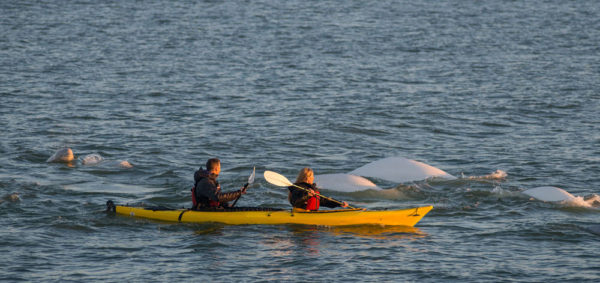
Eventually you figure out how to ride the waves like a pro, but you’d never want to let your guard down. I’d almost gotten to that stage when we ran smack into a school of beluga whales at the mouth of Manitoba’s last great wild waterway, the Seal River, 25 miles north of Churchill on the Northwest coast of Hudson Bay. Twenty or more cows and calves and a few big males spraying and sunning themselves in the choppy waves.

There were two Zodiaks, one with six people and one with seven. The first person brave enough to take the plunge was Margo Pfeiff, a freelance journalist working on a story for the LA Times. How game was Margo? She was suiting up before we even reached the belugas. Our boat was a little less enthusiastic. When our guide Andy MacPherson asked who wanted to be first to swim with the belugas, there was frozen silence.  Nobody volunteered.

“I’ll go in,” I said. “There’s no way I came all the way up here NOT to go in.”

Of course I was only pretending to be brave. I was actually scared. Terrified might have been a better word.  I’d never snorkeled before, and I certainly didn’t think jumping into Hudson Bay a kilometer off shore was the best place to start learning. Especially with the world’s largest land carnivore, the great white polar bear, abandoning the weakening ice pack and looking for something warm and chewy for lunch after a long swim.

Animals can smell fear, right?

But I’d seen photos of others doing it, so it had to be safe. Besides, if Margo could do it, I could do it. And she was already in the water singing Frosty the Snowman to a slippery pod of her own.  I was definitely going in.

So they squished me into a dry suit that makes you look like a floating Michelin Man. There’s no way a polar bear would eat that, right? (I later found out that polar bears love to chew on rubber, and that they had on occasion used Zodiak boats as chew toys.)  I slid over the side of the boat and into the water, already hyperventilating through the snorkeling gear. I then swung my legs up to the boat so they could tie the safety rope around my feet.

“Ok, off you go.”  And I drifted into the sea.

“Put your face down into the water! Stick your toes out! Start singing!”

I could barely hear their voices. Little did they know I was still panicking inside while staring straight down into a dark, wet, unfamiliar world. “Breathe slowly…breathe slowly…,” I thought to myself. And it worked!

I started to calm down. I could breathe fine. The water was cold, but not unmanageable for a tough Winnipegger. It actually felt invigorating. But I couldn’t really see anything. I could hear the whales chirping and squealing and talking to each other, but I couldn’t see them.  I started to sing, “Sweet Home Alabama, Where skies are so blue…” Then it happened.

A huge ghostly white figure appeared and disappeared quickly below me. Then a yellow one. Then another.  The next thing I knew I was face to face with a beluga! And I was comfortable! This was no longer frightening. It was fun!

“Hi there,” I said with a smile. The beluga nodded back, waited a few seconds and vanished.  Just as quickly another appeared, then another. All face to face. I reached out to pat them, but they were always just a smidgeon out of reach. No matter, I was actually talking up close and personal to beluga whales, in THEIR house, and having a ball doing it!

I didn’t stay in the water much longer.  Somehow my conversation (or singing) wasn’t quite holding the belugas’ attention. Actually, it was one of those rare occasions when I was at a loss for words. I really need to brush up on my undersea conversation skills. Like Susan Knight, a Consultant Rheumatologist from the UK who was the next to make the voyage into the water.

Unlike Margo, who had some measure of success attracting the belugas with her gurgling version of House of the Rising Sun, Susan was singing what sounded like a Christmas carol.  Whatever it was, it worked. The belugas loved it! It seemed only fitting that the “Canaries of the Sea” would love a Christmas carol and Susan soon had a choir of happy belugas following her intently. In fact, they were turning around and making a beeline for her from all directions. The Beluga Queen, they all wanted a word with her.

YouTube Preview Image

In the other boat guided by Terry Elliot, Colin Earl, an Australian living in Canada and working in a mine in Russia, also had the language of the whales aced. It seems his experience with wildlife in numerous countries transferred to the water. He made the video above, and had a great chat with his sleek new friends. One of them even gave him a love bite. He said it never happened. (His wife Vicki was in the boat above keeping a close eye on him.)

Regardless, I got none of that action.  But I did conquer my fear of the unknown!  And it was, after all, my first date… with a beluga whale.


Read more about swimming and snorkeling with the beluga whales, walking with polar bears and trekking the tundra with Churchill Wild, in Margo Pfeiff’s article, The Arctic warmth of Hudson Bay’s belugas, that appeared in the L.A. Times Travel section.


Learn more about swimming with beluga whales on the Birds, Bears and Belugas Adventure page at Churchill Wild.

Disclaimer: George Williams does contract Internet work for Churchill Wild.