Sign Up for our Newsletter!
1-866-UGO-WILD (846-9453)

Posts Tagged ‘polar bears’

Magazine editor Katie Nanton details trip to see Churchill polar bears at Seal River Heritage Lodge

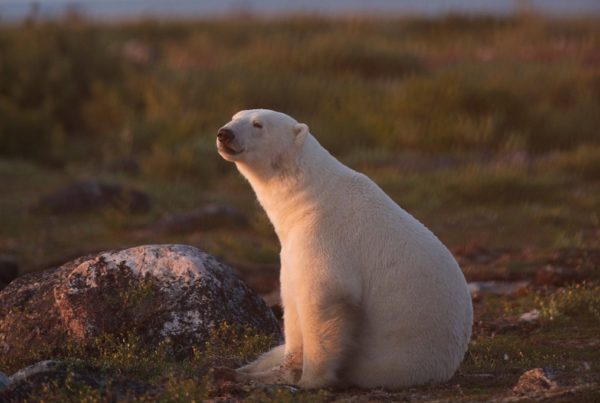
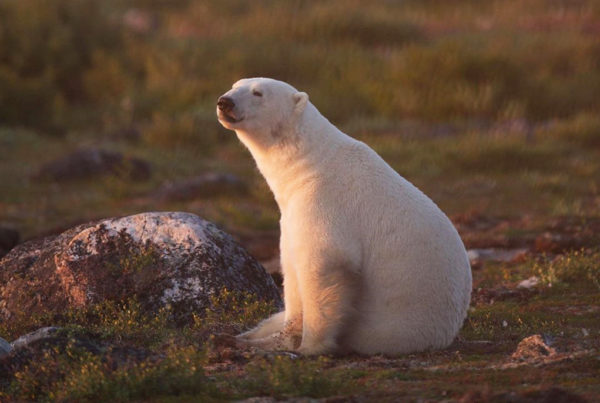
Polar bear relaxing on rocks at Seal River Heritage Lodge

Polar bear relaxing on rocks at Seal River Heritage Lodge - Photo Credit: Robert Postma

Katie Nanton, an assistant editor with NUVO Magazine, was at Seal River Heritage Lodge for the Birds, Bears and Belugas Adventure last summer.

A seasoned adventure traveler, writer and editor with world-wide safari experience, Katie wrote a story about her Churchill Wild experience for NUVO entitled A Canadian Safari – Churchill, Manitoba: the polar bear capital of the world, which appeared in their Spring 2011 Issue. Below are a few excerpts from Katie’s Story with a link to a PDF of the story at the end. Enjoy!

First polar bear

I see the first bear in the distance. A big, beautiful Ursus maritimus. Adrenaline kicks in and the quiet chatter halts, followed soon after by the clicking of camera shutters and zooming of lenses. Our guides remind us to be silent – although this bear is familiar with the presence of people by now, we don’t want to disturb or frighten it – and we take a few steps forward until I’m standing about 10 metres away from this larger-than-life beauty. I eye the guns slung over our guides’ shoulders: loaded, and a necessary precaution, they are very rarely used, and only to scare off an approaching bear. Nothing stands between us and this wild animal but a short distance and a few rocks; polar bears are capable of running up to 40 kilometres an hour.

A  fight in the morning

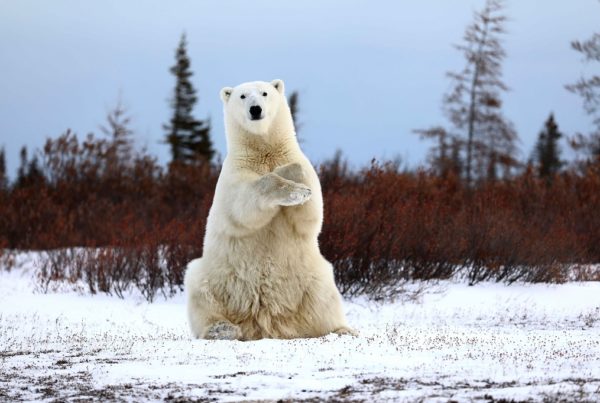
One foggy morning, I awaken to an early morning knock on my bedroom door and a commotion outside. A night watchman stands  guard over the lodge each night, eyes peeled for curious bears and Northern Lights. I’m expecting flashes of green and blue aurora borealis, but out of the main-room window is a more unexpected early morning sight: far in the rocky distance, two bears are stretched up on their hind legs, standing at least eight feet tall, their furry arms in the air like boxers, jabbing, dodging, and blocking each other, paws flailing. Their show of strength is spellbinding. I want to get closer. I walk with my guide until we come within about 15 metres…

Full PDF: A Canadian Safari – Churchill, Manitoba: the polar bear capital of the world

————————————————————————————————————————————————–

About NUVO Magazine

NUVO Magazine LogoInspired by quality, NUVO is a lifestyle magazine for the Canadian sophisticate. It is our mandate to create an editorial environment that is stimulating, evocative, entertaining and informative, and relevant to both the amateur and the connoisseur.  The NUVO reader is the inquisitive, culturally aware, well-travelled urbanite who appreciates a blend of insight and entertainment. We share the NUVO reader’s discerning taste in travel, food and wine, film and TV, fashion, art, architecture, design, business, automobiles and music.  NUVO features the finest in writing, photography, illustration, design and production. Our commitment to quality is essential to being a leader in the magazine industry. It is thus our assiduous intention to craft a magazine that is quite simply unlike any other.

Polar Bears in the News

polar bear newsThere have been a lot of polar bear stories in the news lately and here is a quick round up.

Godfather of polar bear scienceEdmonton scientist Ian Stirling’s new book on polar bears wasn’t even in bookstores this summer when a venerable American wildlife magazine posted a gushing review.

::

The latest, Polar Bears, The Natural History of a Threatened Species, is a handsome book of articles and photographs that is a memoir, a reference book, a science book, a coffee-table book and a lament for a species that could disappear from most of its range sometime within the next half-century.

Stirling spends a lot of time and effort in Churchill and does work with Polar Bears International. PBI is offering signed copies for sale on their website. If you’re interested in Stirling’s book you can find it here.

Here’s another interesting story that is sure to have many expressing concern:

A mother polar bear swam for nine days straight to reach sea ice, covering nearly 700 kilometres and losing her cub in the process, according to a new study on the movement of female polar bears.

The study, which links shrinking sea ice as a possible threat to polar bear cubs, also noted the bear lost 22 per cent of her body weight after swimming in the Beaufort Sea.

Luckily the polar bears in Hudson Bay don’t have quite that far to go to get off the sea ice – could be the reason we see so many healthy bears around the Seal River Heritage Lodge.

The Beaufort Sea is north of Alaska & the Yukon. There seems to be a story like this every year in the news.

And while there are reports of bears swimming incredible lengths and drowning, today comes a story of a scientist who did some of those studies being investigated:

A U.S. wildlife biologist whose observation in 2004 of presumably drowned polar bears in the Arctic helped to galvanize the global warming movement has been placed on administrative leave and is being investigated for scientific misconduct, possibly over the veracity of that article.

Here is a tidbit on polar bear (and grizzly and black bear) safety information:

A study published in 2008 in The Journal of Wildlife Management looked at the efficacy of bear spray as a deterrent involving grizzly, black and polar bear encounters in Alaska from 1985 to 2006.

In 72 cases where people sprayed bears to defend themselves, 98 per cent walked away uninjured.

That’s good to know if you’re ever out there alone in the woods. When we walk with polar bears at the lodges we travel in groups. Our polar bear guides – Andy & Terry – are 100% pros when it comes to keeping our guests safe.

There are other interesting bear facts and stats in that article. Make sure you give it a read if you ever plan to go hiking through the Canadian Wilderness alone (not recommended without Andy or Terry present). You DO NOT want to cause a stir like this guy:

Conservation officers in northeastern Manitoba were forced to fatally shoot a polar bear after it ran after a tourist and charged at a truck.

Laura Gray-Ellis said she was at the health centre in Churchill on Monday morning when she saw a tourist at the beach snapping photos just three metres from the bear.

That’s what happens when people do not follow the posted rules and disrespect polar bears. Just plain stupid.

There’s also a super-great, super-fantastic, super-yummy story about an Arctic cuisine/Canadian wine pairing that is happening at Seal River Heritage Lodge this weekend.

Churchill Wild, which owns and operates Canada’s premier polar bear lodges for viewing polar bears in their natural environment, has partnered with Banville & Jones Wine Co. in Winnipeg to celebrate Food Day Canada 2011 on July 30 with a wine-pairing event at their remote Seal River Heritage Lodge in Northern Manitoba, Canada.

And from the always strange (and how things have changed) files – here’s an old newspaper clipping from 1951 entitled “Crippled Polar, Four Monkeys, Bear Still Free” A circus trailer overturned and released a bunch of animals in Arkansas. Among them was a polar bear.

Notice the $200 reward if anyone can capture the polar bear alive!

Polar Bear Capital: Report from Seal River – Birds, Bears & Belugas

by Allison Reimer

Peek-a-boo polar bear

Peek-a-Boo Polar Bear

It’s been a slower week at the Seal River Heritage Lodge because of the cool and cloudy weather but who can control that?

Thankfully the outdoor conditions haven’t deterred our adventurous polar bears, who have been plentiful for the opening week of Birds, Bears & Belugas.

We had a beautiful, big white bear wander by two days ago and last night we had a visit from a smaller bear. He sniffed around the lodge for quite some time and stood up to peer into the windows every once and a while.

Everyone was very excited – rushing from window to window as quietly as possible so as not to scare him off. Eventually he meandered off to get some rest and once the excitement died down we all followed suit.

Polar Bear Dune Buggy Camera

Our videographer, Stuart, configured two cameras on top of what resembles a mini dune buggy in attempts to get Polar Bear footage at a closer (but safer for him) distance.

The guests are off on a new adventure today – a trip out to explore the tundra flats. We also have a group of travel agents from around the world visiting us for lunch today, courtesy of Travel Manitoba.

Thank You!

Arctic Safari: The Qamanirjuaq Caribou Herd

Four caribou on tundra ridge in Northern Manitoba, Canada

Caribou family outing. Photo Credit: Dennis Fast

by Rick Kemp

With the launch of the Churchill Wild Arctic Safari we are excited to be featuring something we have wanted to give our guests for over a decade – a fly out to witness a stunning caribou migration and a chance to experience Canadian arctic wildlife at its finest, all while immersed in a kaleidoscope of fabulous fall colors!

Churchill Wild’s polar bear tours will never be the same!

Polar bears are always the marquee stars of any Churchill Wild adventure but equal billing for the Arctic Safari can surely go to the caribou of the Qamanirjuaq herd. The Qamanirjuaq caribou herd (ka-min-YOO-ree-ak) is estimated to be between 300,000 to 400,000 strong, and Churchill Wild has located the perfect spot on the migration route to witness this stunning spectacle.

The Qamanirjuaq continues to have strong numbers, despite population declines in other major caribou herds in Canada’s North. The total area used by the herd during their migration spans more than 500,000 square kilometers north to south along the Hudson Bay’s west coast. The winter range primarily consists of forested lands in northern Manitoba and tundra in Manitoba and Nunavut.

In Inuit mythology Tekkeitsertok is the master of caribou, one of the most important gods in the pantheon. Many Dene and Inuit historically depended on caribou for food, clothing and shelter; so much so that the Inuit of the area were given the name “Caribou Eskimo” by early European explorers.

The Inuit survived by hunting and trapping in family groups while living in what is now Nunavut and Northern Manitoba. Although apprehensive for many generations, they began trading regularly with the Europeans in the early 1900s and by the late 1950s were moving into communities. They were encouraged by government to do this so their children could attend school and have access to medical care.

Today, the Qamanirjuaq caribou continue to be very important in maintaining the culture and traditional lifestyles of Dene, Métis, and Inuit across the north by providing food, materials for traditional clothing, special tools & shelter.

Tupik at Dymond Lake Lodge

Tupik at Dymond Lake Lodge

One of the shelters that was traditionally constructed is called a “tupik”. Last fall an Inuit couple named Peter and Mary graciously visited to teach our guests about their culture and their way of life during the Great Ice Bear Adventure at Dymond Lake Ecolodge. Peter and Mary built the tupik to show us what they would live in while traveling and hunting during the summer months in the north. The tupik is constructed of about 20 caribou hides and long skinny timbers.

An Inuit legend about the origin of caribou goes like this:

Once upon a time there were no caribou on the earth. But then there was a man who wished for caribou, and he cut a great hole deep into the ground, and up through this hole came caribou, many caribou.  The caribou came pouring out, till the earth was almost covered with them.  And when the man thought there were caribou enough for mankind, he closed up the hole again. Thus the caribou came up on earth.

The numbers of caribou seem to be inconsistent but plentiful. Distribution and migration of 10 adult female Qamanirjuaq caribou have been monitored since 1993 using radio-collars and tracked by satellites. The results of this study have provided insight to the herd’s recent distribution and movement patterns. This link has a downloadable QuickTime movie that shows a typical caribou migration route.

While Churchill Wild goes to great lengths to preserve the natural habitat we encounter, there are some external threats that are concerning. Hydro transmission lines, roads to communities in northern Manitoba, mineral exploration and mines are all issues local groups have voiced concern with. These activities continue to spread to the calving and post-calving areas.  Hydro-electric development could affect movement of the herd during spring and fall migration as they may need to make detours if traditional water crossing sites are impassable due to water level changes from hydro dams.

As a way of addressing these and other concerns the Beverly & Qamanirjuaq Caribou Management Board (BQCMB) was established in 1982 to coordinate management of the herds.  The Board’s responsibility is to make recommendations to government and conduct projects for conservation and management of the caribou herds and their habitat.

There are times when a caribou is in the vicinity of one of our lodges and guests are always amazed with their grace. To see one as part of a herd is fascinating and a spectacle we are excited to present as part of our Polar Bear Arctic Safari.

But caribou and polar bears? Together? Polar bears are often said to be the world’s largest land predators and our experienced guides (Andy & Terry) keep the guests safe. What about the caribou?

While there have been very few documented cases of the two species interacting, some observations indicate that polar bears will stalk and chase caribou, but you would not likely witness it during your adventure with Churchill Wild.

Fall colors in the arctic

Spectacular fall colors in the Arctic. Photo Credit: Dennis Fast

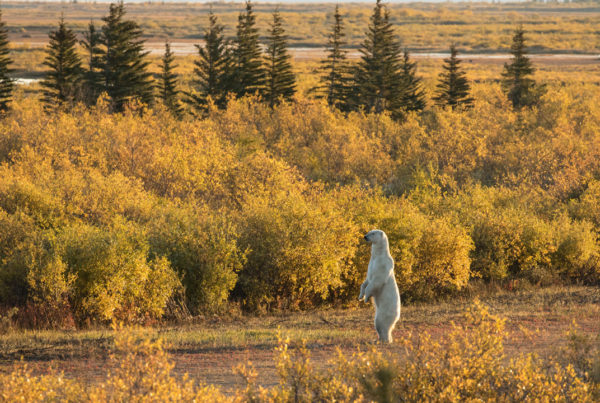
Churchill Wild’s polar bear guides have been reporting an increasing number of polar bear sightings on the caribou range, with bears spotted as far as 150 kilometres from the coast in recent years.

Last summer a polar bear found its way as far south as Shamattawa, Manitoba – about 400 kilometres away from the Hudson Bay coast. These instances are extremely rare but the phenomenon could explain the “grolar” or “pizzly” bears (which we will pretty much guarantee you will NOT see!)

Churchill Wild’s Arctic Safari is easily our most ambitious adventure to date and the timing is essential. A small window in early September provides the perfect apex to see the widest variety of wildlife and brilliant displays of the Aurora Borealis.

The Arctic Safari takes you over 20,000 square kilometres of the wildest regions in the Arctic; providing the potential “Big Five” (and then some) of wolves, caribou, moose, three species of bears (polar, black and grizzly), belugas, arctic and colored fox, wolverine, beaver, pine marten, arctic birds and of course, spectacular Northern Lights.

For more information about the Arctic Safari or any of our Arctic Adventure Travel Experiences, please call our office, sign up for our newsletter or e-mail us at info@churchillwild.com. We would love to hear from you!

Could President Obama and family walk with Churchill polar bears? Yes. They could.

Polar Bear Viewing Observatory Dining Room on Hudson Bay

New polar bear viewing observatory/dining room at Seal River Lodge on the Hudson Bay Coast

When Canadian Ambassador Gary Doer’s daughters Kate and Emily invited U.S. President Barack Obama’s daughters Sasha and Malia to visit the polar bears in Churchill a few years ago it got us thinking. They probably considered visiting Churchill, but it’s unlikely they knew they could actually walk on the tundra with polar bears, or swim in Hudson Bay with beluga whales.

Churchill Wild eco-lodge owners Mike and Jeanne Reimer say the Obama and Doer families would be more than welcome to do just that at their Seal River Heritage Lodge 40 miles north of Churchill on the Hudson Bay coast.

“It’s the only place in Canada where you can actually go out and walk with the polar bears in their natural environment,” said Mike Reimer, who has been stomping the terra with the polar bears for over 30 years. “We would absolutely love to have the Obama and Doer families visit our polar bear eco-lodges and take part in all the activities we have to offer.”

Polar bear outside new Seal River Lodge dining room Summer 2010

Polar bear intently watching Hudson Bay outside Seal River Lodge

That of course, would include walking with polar bears on the coast of Hudson Bay and snorkeling with beluga whales in Hudson Bay, not to mention eating gourmet meals straight from the award-winning cookbook series Blueberries and Polar Bears, which were co-written by Jeanne Reimer’s mother Helen Webber of Webber’s Lodges.

Helen is married to Webber’s Lodges owner and former Churchill mayor Doug Webber. She is certainly no stranger to hosting dignitaries at the Webber’s home in Churchill and preparing spectacular feasts for them, including Ambassador Doer when he was Premier of Manitoba,

Helen’s dinner parties in Churchill are legendary, the last of which was held for the top international executives of the Canadian Tourism Commission, who later flew out to see the polar bears at Seal River Lodge. The dinner, and the trip to Seal River Lodge, received rave reviews.

Gourmet Dinner at Churchill Wild

Gourmet Goose Dinner at Churchill Wild

First Lady Michelle Obama, who is promoting healthy eating as her platform while in the White House, would likely enjoy herself immensely in Churchill Wild’s family-run tundra kitchen, which prides itself on utilizing the freshest ingredients available from the surrounding landscapes.

Mrs. Obama launched her Let’s Move initiative to battle childhood obesity and improve the quality of food in U.S. schools in February, 2010 and on March 16, 2011 she reached an agreement with Crown Publishing Group to author a cookbook in which she will talk about the garden she established on the South Lawn of the White House. Due out in 2012, Mrs. Obama’s new cookbook will also explore how improved access to fresh, locally grown food can promote healthier eating habits for families and communities. You can watch the video about the White House Garden here.

“Last year we built the new dining room,” said Reimer. “Right now we’re hauling in a new gourmet kitchen. It was designed by Len Friesen and it will be the first of its kind in the arctic. We’re planning on having a Celebrity Chef Contest at some point with a combination of original creations and recipes from the Blueberries and Polar Bears cookbooks that will feature seal, caribou, moose, goose, arctic char, northern pike, lake trout, local plant garnishes, wild blueberries, cranberries and strawberries. In between cooking sessions we’ll be out on the tundra with the polar bears or swimming with whales. We would love for Mrs. Obama to participate!”

But seriously, fabulous food and cooking contests aside, what about safety and secret service and fighter planes?

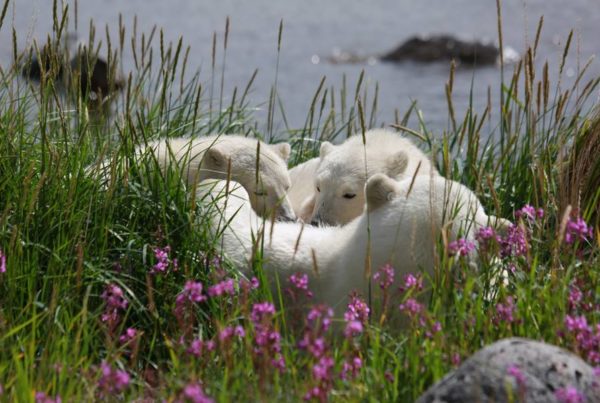
Polar bear in fireweed at Seal River Lodge on the Hudson Bay Coast near Churchill

Polar bear in fireweed. Photo Credit: Dennis Fast

“We’ve never had a polar bear problem in the 30 years that we’ve operated our lodges,” said Reimer. “It’s a unique, once in a lifetime experience and our guests love being able to get up close and personal with the polar bears. It’s one of the few places on earth where you can actually go out and walk with the bears, and there are numerous safety measures in place. I’m not sure what the bears would think of secret service agents and jet fighters. They probably wouldn’t even notice.”

While he was Premier of Manitoba, Ambassador Doer persuaded numerous high-profile people to visit Churchill, including Janet Napolitano, who is now President Obama’s Secretary of Homeland Security; David Wilkins, the former U.S. ambassador to Canada; and Prime Minister Stephen Harper.  Last fall, famous visitors to Churchill included George Stroumboulopoulos, Chantal Kreviazuk, Raine Maida and Martha Stewart.

Still, try to imagine the Turbo Beaver taking off from Churchill for Seal River Lodge accompanied by fighter jets. Or the curious looks on the polar bears’ faces when the secret service agents arrive with the Obama family. And what kind of boat would be required if the Obama and Doer families decided to go swimming with the beluga whales? Would the Zodiaks suffice?

“It would something very special for us,” said Reimer. “We would like to extend a heartfelt open invitation to both the Obama and the Doer families to visit Seal River Lodge any time. It would be an incredible honor.”